Open 7 days: Mon to Sat 7am to 9:30pm, Sun 9am to 9pmLicensed and insured, MHIC #1459775921 Moravia Park Dr b6, Baltimore, MD 21206
Custom Fabrication

Waterfall Edge Countertops in Baltimore

A waterfall edge carries the countertop over the end of an island or peninsula and straight down to the floor, so the stone reads as one continuous folded piece. TopStone Granite fabricates and installs waterfall edge countertops in quartz, marble, quartzite and granite for kitchens across Baltimore and the surrounding counties.

The effect depends on two things a photo hides: a crisp 45 degree miter and a side panel cut from exactly the right part of the slab. With 15+ years in stone and 650+ completed jobs, we plan both on the slab before anything is cut.

Waterfalls suit islands, peninsulas, bar ends and even desks and vanities. We are licensed and insured, and you can look up MHIC #145977 with the State of Maryland.

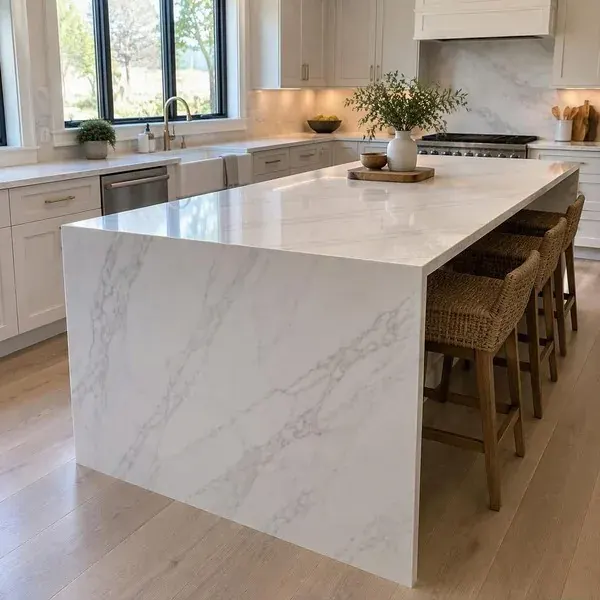
White marble waterfall edge island with continuous veining down the side panel in a bright Baltimore kitchen
Licensed and insured
MHIC #145977
  • 15+years fabricating and installing
  • 650+countertop jobs completed
  • 7 daysopen every day of the week
  • Localshop on Moravia Park Drive, Baltimore

Our Waterfall Edge Countertop Services

A waterfall is a custom fabrication detail, not an add-on panel bolted to the side of a cabinet. We handle the whole job so the top, the miter and the leg are planned as one piece:

  • A waterfall on one end of an island, or on both ends for a full wrap
  • Peninsula ends where the counter turns down beside a walkway or seating area
  • Slab layout so the side panel continues the pattern from the top
  • Cutting and bonding the 45 degree miter
  • Leveling, anchoring and installing the panel to the floor
  • Sink, cooktop and seam work on the rest of the island at the same time

Waterfalls work best on islands with finished flooring already installed and cabinets anchored firmly to the floor. If your island is still on paper, we can advise on overall length so the top and both legs fit the slabs you like.

One end or two is the first decision. A single waterfall on the end that faces the room delivers most of the drama for less stone, while a double waterfall frames the island like a piece of furniture. Seating overhangs work with either, though a long overhang may still need hidden steel supports where no leg carries it.
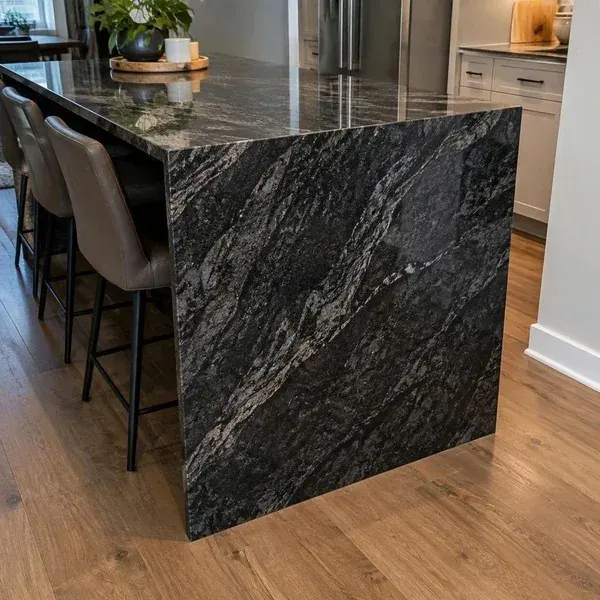
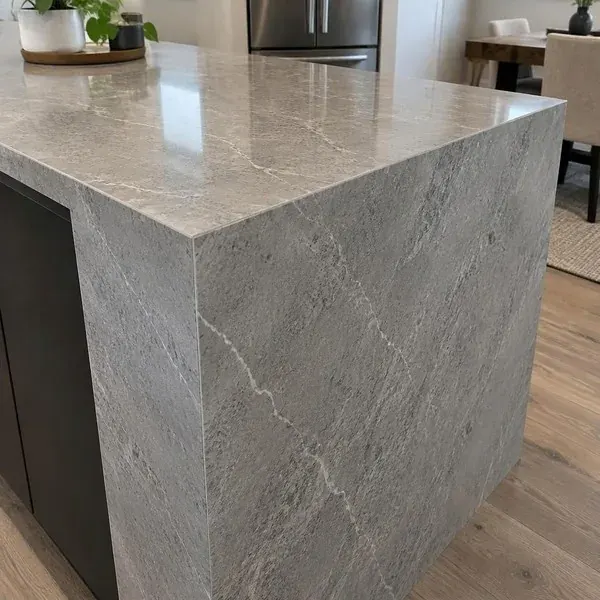
Granite waterfall side panel meeting the finished floor at the end of a kitchen island

How a Waterfall Edge Is Made

A good waterfall looks simple, which is exactly why every flaw shows. These three steps decide whether the corner disappears or draws the eye.

Close-up of a tight mitered waterfall edge seam where a countertop meets its side panel

Mitered 45 Degree Joints

A square butt joint leaves the slab's edge thickness showing as a stripe down the corner. Cutting both pieces at 45 degrees hides that stripe, so the top and the leg appear to be one block of stone.

The two faces are bonded with epoxy tinted to the stone, then clamped while it cures. The finished corner is lightly eased so it is not razor sharp.

Matching the Vein Down the Side

To keep the pattern flowing, the side panel is cut from the slab section directly next to the end of the top piece. A vein that runs off the edge of the island top then continues down the leg.

That means the layout is planned on the slab, not on a drawing, using the same approach as our seam and vein matching. It sometimes leaves more offcut, which is part of why waterfalls use more stone.

Anchoring the Leg and Floor Clearance

The panel is secured to the cabinet end or a support panel with adhesive and brackets, then leveled so it stands plumb under the miter. Many fabricators leave a small gap, often around 1/8 inch, between the panel and the floor so seasonal floor movement does not push on the stone.

The island cabinets themselves must be fastened down. A loose island will eventually stress the miter.

Materials and Patterns That Suit a Waterfall

Veined stone shows off a waterfall best. A bold vein in Calacatta-style quartz or a white marble that turns the corner and runs to the floor is the look most people picture, and it rewards careful layout. Quartzite gives a similar effect with more hardness.

Busy, speckled granite is forgiving because it hides the miter line almost completely. The trade-off is that the continuous wrap is less noticeable, so you pay for a waterfall that reads more like a stone side panel. Solid and lightly patterned quartz sits in between: clean and modern, with a miter that must be very tight because there is no pattern to hide it.

Thickness is a smaller choice than it seems. Most waterfalls are made from 3 cm stone, but 2 cm works too and weighs less, and the miter makes either one look solid from the side.

Slab yield matters as much as color. A side panel is roughly the depth of the island by its height, so a large island top plus two legs often needs more than one slab. Compare the options on our marble countertops and quartz countertops pages.

What Drives Waterfall Countertop Cost

A waterfall island costs more than the same island with a standard end, and the reasons are mostly material and labor, not markup:

  • Extra square footage: each leg adds a panel about as large as the island depth by its height.
  • A second slab: vein matching, a long island or two legs often push the job onto another slab.
  • Miter labor: cutting, bonding, clamping and finishing a long miter takes far more time than polishing an edge.
  • Layout waste: taking the leg from the right section of the slab can leave offcuts that cannot be used elsewhere.
  • Installation: heavy panels need extra hands, careful leveling and a plumb set to the floor.

Our countertop cost guide explains how these combine with material and edge pricing for a full kitchen.

Protecting Waterfall Edges From Chips

The exposed corners of a waterfall take more knocks than any other part of the island. Bar stools, vacuum heads, shoes and cleaning carts all hit the bottom corner, and hips and pots catch the top one.

A slightly eased or rounded miter corner resists chipping far better than a knife-sharp one. Felt pads on stool legs and a little care with the vacuum go a long way. Dark quartz shows chips as light spots, so it benefits most from an eased corner.

If a corner does chip, it can usually be filled with color-matched epoxy and polished back rather than replaced. Our countertop repair team handles chipped miters and edges.

Answers from our team

Waterfall Countertop FAQs

Does a waterfall island need a second slab?

Often, yes, but not always. It depends on island length and depth, whether you want one leg or two, slab dimensions and how strictly the veining has to match. We lay out the pieces on your actual slab sizes so you know before you buy.

Can you add a waterfall edge to an existing island?

It is possible but rarely looks right. Matching an existing top means finding a slab from the same material and color, and natural stone and even quartz lots vary. Pattern continuity across the miter is nearly impossible, so most people replace the island top and legs together.

Is a waterfall edge worth the extra cost?

It is worth it if you want the island to be the centerpiece of the room and you like the clean, modern lines. It also protects the cabinet end from scuffs. If budget is tight or the stone is busy granite, a standard end with a nice edge profile may give you more value.

Can a waterfall panel be lit?

Yes. LED strips can wash light down a waterfall panel or sit under the overhang beside it, as long as the wiring is planned before fabrication. See our countertop lighting installation page for the options.

Request a quote

Design Your Waterfall Island

Tell us your island size, the stone you are drawn to and whether you want one waterfall end or two. We will show you how the slab lays out before you commit.

Call (667) 400-3297
Call (667) 400-3297Quote