Open 7 days: Mon to Sat 7am to 9:30pm, Sun 9am to 9pmLicensed and insured, MHIC #1459775921 Moravia Park Dr b6, Baltimore, MD 21206
Countertop Repair

Marble Countertop Repair and Polishing in Baltimore

TopStone Granite restores marble countertops, vanity tops and islands across Baltimore. We remove etch marks and stains, polish dull marble back to its shine, fill chips and cracks, and reseal the stone so it is ready for daily use again.

Marble is soft and reacts with acid, so most marble damage is surface wear rather than breakage. That makes marble work more restoration than repair: honing and polishing the surface, with fills reserved for actual chips and cracks. Our team brings 15+ years of stone fabrication and 650+ completed jobs to it.

We work on Carrara, Calacatta and other marbles in kitchens, bathrooms and bars within about an hour of Baltimore. TopStone Granite is licensed and insured under MHIC #145977.

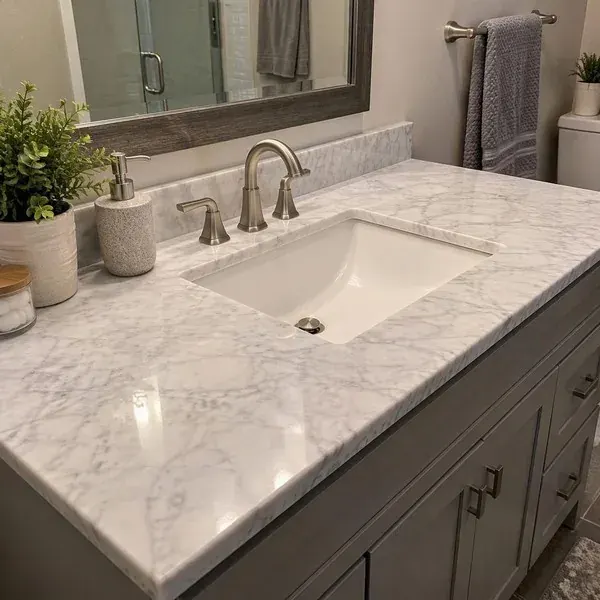
White marble vanity top around a faucet base, where etching and water marks call for marble repair in Baltimore
Licensed and insured
MHIC #145977
  • 15+years fabricating and installing
  • 650+countertop jobs completed
  • 7 daysopen every day of the week
  • Localshop on Moravia Park Drive, Baltimore

Our Marble Countertop Repair and Polishing Services

Most marble restoration happens in place, on the countertop you already have. Our marble repair and polishing services include:

  • Etch removal, from light water rings to deep dull spots from citrus, wine or vinegar
  • Honing to remove scratches and wear, or to change the finish to matte
  • Marble polishing to bring a polished finish back to an even, reflective shine
  • Stain removal with poultices matched to the type of stain
  • Chip and crack repair with clear or tinted fills
  • Resealing once the surface is clean and restored

Marble polishing is not a coating or a wax. It is a mechanical process that removes a microscopic layer of damaged stone and refines what is underneath, which is why the results last when the marble is cared for.

Etching vs. Staining on Marble

Most marble owners call every mark a stain, but etching and staining are different problems with different fixes. A stain is darker than the stone around it. An etch is a dull, lighter, rough-feeling spot, and on polished marble it is far more common.

What Causes Etch Marks

Marble is calcium carbonate, so acids dissolve its surface on contact. Lemon juice, vinegar, wine, tomato sauce, soda and some bathroom cleaners all leave dull marks, often in the shape of the spill or the bottom of a glass. Sealing does not prevent etching, because sealer slows absorption but cannot stop an acid reacting with the stone.

Lifting Stains With a Poultice

A stain is something absorbed into the marble, and a poultice draws it back out. Oil stains from cooking or cosmetics need a solvent-based poultice, while organic stains from coffee, tea and wine usually respond to a peroxide-based one. Rust and some dye stains are stubborn, and we will tell you honestly if one is unlikely to come out.

Honing and Polishing Options

When we restore marble, you choose the finish it ends up with. Most marble is installed polished, but restoration is the natural moment to rethink that.

Restoring a polish. Light etches can often be polished out directly. Deeper ones are honed first with diamond abrasives in progressively finer grits, then polished back to a reflective shine across the whole surface so there are no patchy spots.

Switching to honed. A honed finish is a smooth matte surface. Etching still happens, but it is much harder to see on honed marble, which is why many kitchen owners switch. Honed marble can show oil stains a little more easily, so keeping it sealed matters.

Changing finish is a whole-surface job, not a spot treatment, because a honed patch on a polished top looks like damage. For refinishing other stones, see our countertop resurfacing page.
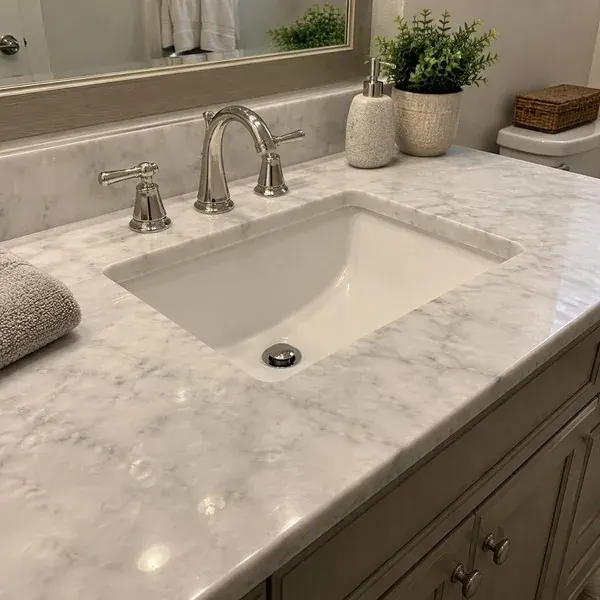
Sealed white marble bathroom vanity top restored to an even polished finish

Repairing Chips and Cracks in Marble

Marble chips at edges and corners and cracks near sink cutouts and faucet holes, especially on thinner vanity tops. Because it is softer than granite, a marble repair needs a gentle touch during leveling and polishing so the area around the fill is not scratched.

White marbles like Carrara and Calacatta are translucent, and light passes slightly into the stone. A chip fill has to be tinted with that in mind, often using a clear base with a small amount of white and gray, or it will look flat and chalky.

The veins in Carrara and Calacatta are natural lines of weakness, and cracks often follow them. We fill along the vein so the repair reads as part of the pattern. Where a crack runs through a narrow section near a sink, the underside can be reinforced to stop it opening further.

If your vanity top is cracked past saving, our bathroom vanity countertops page covers replacement, and our marble countertops page explains what to know before choosing marble again.

Marble Restoration Cost Factors

Marble restoration is priced by the job after we see photos or the countertop. These are the factors that matter most.

  • Spot work or the whole surface. Polishing out a few etches costs less than honing and polishing an entire kitchen.
  • Depth of etching and scratches. Deep damage needs coarser honing first, which adds steps and time.
  • Finish change. Switching from polished to honed means working every square inch of the top.
  • Stains. Poultices need time to draw a stain out, and stubborn stains can take more than one application.
  • Chips and cracks. Fills and any underside reinforcement are priced on top of surface work.

For the cost of new marble instead, our Baltimore countertop cost guide breaks down what drives installation pricing.

Keeping Marble Looking Good After Restoration

A restored marble top stays good-looking far longer with a few habits.

  • Clean with a pH-neutral stone cleaner or mild dish soap and water. Avoid vinegar, lemon-based sprays and most all-purpose bathroom cleaners.
  • Use coasters and trays under glasses, perfume bottles and soap dispensers.
  • Wipe up acidic spills right away, especially wine, juice and tomato.
  • Use trivets and cutting boards. Marble scratches more easily than granite or quartz.
  • Reseal when water stops beading and starts darkening the stone within a few minutes.

For ongoing sealing and periodic polishing on marble and other natural stone, see our stone sealing and polishing service. For chips and cracks on harder stones, our granite countertop repair page explains the process, and the full range of repairs is on our countertop repair hub.

Answers from our team

Marble Repair FAQs

Can etch marks be removed from marble?

Yes. Light etches can usually be polished out, and deeper etches are honed first with fine diamond abrasives and then polished back to an even finish. Because etching is surface damage, it can almost always be removed without replacing the stone.

Should I switch my marble to a honed finish?

Honed marble hides etching far better, which makes it a good fit for busy kitchens where acidic spills are common. The trade-off is a matte look without reflection, and slightly more attention to oil stains and sealing. If you love the shine and do not mind occasional polishing, keeping the polish is fine.

How often does marble need professional polishing?

It depends on how the marble is used. A busy kitchen with polished marble may benefit from polishing every year or two, while a powder room vanity can go many years. Etches that bother you are the best signal, rather than a fixed schedule.

Does sealing marble stop etching?

No. Sealer reduces how quickly liquids soak in, which helps prevent stains, but acids still react with the marble surface. Good habits and a honed finish are the best defenses against etching.

Request a quote

Restore Your Marble Countertops

Email a few photos of the etch marks, stains or chips to info@topstonegranite.com, or call and tell us about your marble. We will explain what polishing can and cannot fix before we start.

Call (667) 400-3297
Call (667) 400-3297Quote