Open 7 days: Mon to Sat 7am to 9:30pm, Sun 9am to 9pmLicensed and insured, MHIC #1459775921 Moravia Park Dr b6, Baltimore, MD 21206
Countertop guide

Countertop Edge Profiles: A Visual Guide for Baltimore Kitchens

The edge profile is the shape cut and polished into the exposed side of your countertop. It changes how the whole kitchen looks, how comfortable the counter is to lean on, and how well the stone holds up to bumps from pots and dishes. TopStone Granite shapes edges on granite, quartz, marble and quartzite for homes and businesses across Baltimore.

With 15+ years of fabrication and 650+ completed jobs, we have seen which edges stay crisp for decades and which ones chip near the dishwasher. We are licensed and insured under MHIC #145977.

This guide walks through the common profiles, which ones work best for busy households, how thickness changes your options, and which edges add to the price.

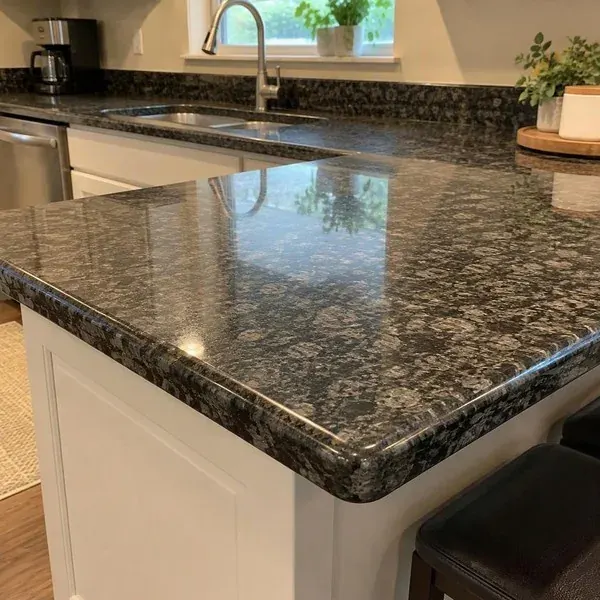
Polished dark granite countertop with a rounded half bullnose edge, one of the edge profiles in this guide
Licensed and insured
MHIC #145977
  • 15+years fabricating and installing
  • 650+countertop jobs completed
  • 7 daysopen every day of the week
  • Localshop on Moravia Park Drive, Baltimore

Common Countertop Edge Profiles

Most kitchens use one of five edge shapes. Each has a different look, feel and level of chip resistance.

Eased Edge

An eased edge is a squared edge with the top and bottom corners slightly softened. It reads as clean and modern, works with every stone, and is the most common choice today.

The small radius takes the sharpness off the corner, which makes it far less likely to chip than a truly square edge. It is also the simplest edge to repair if it ever does get nicked.
Bullnose and Half Bullnose

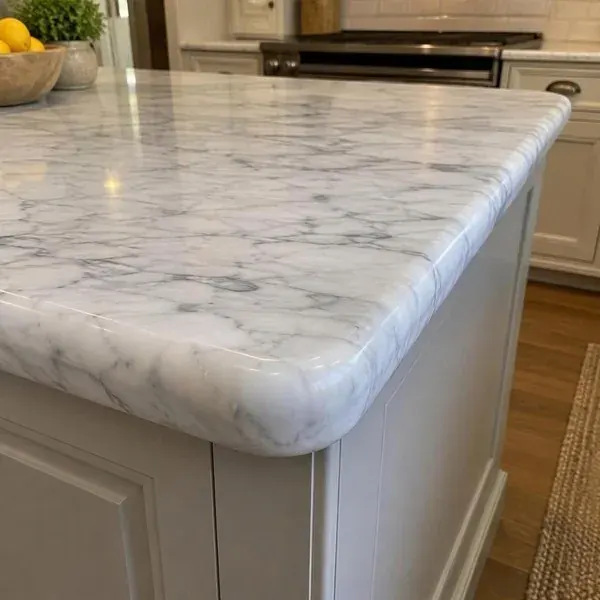
A full bullnose rounds the edge from top to bottom into a smooth half circle. A half bullnose rounds only the top and leaves a flat, square bottom.

Both are soft to the touch and forgiving on hips and small heads, which is why families like them. Half bullnose tends to shed spills more cleanly, since drips fall straight off rather than curling under toward the cabinet fronts.

Bevel

A bevel cuts a flat, angled face, usually 45 degrees, along the top corner. It gives a crisp, tailored line that catches the light and suits transitional and contemporary kitchens.

The lower corner stays fairly square, so it is worth softening slightly in high-traffic spots.

Ogee

An ogee edge is a decorative S-shaped curve with a step at the top. It is the classic choice for traditional kitchens with raised-panel cabinets and furniture-style details.

Ogee takes more shaping and polishing time, so it usually costs more than simpler edges. Its grooves also collect crumbs, and a chip in the curve is harder to blend than one on a flat face.

Mitered Edge

A mitered edge joins a second strip of stone to the countertop at a 45-degree angle, creating the look of a much thicker slab. With careful cutting, the veining wraps continuously over the edge.

It is the edge behind most modern islands and the starting point for a waterfall edge countertop, where the stone continues down to the floor. Mitered edges are labor intensive and among the most expensive profiles.

Other Edge Options to Know

Beyond the big five, a few specialty profiles come up often:

  • Dupont: a square top step that drops into a rounded lower curve, popular on islands and bar tops.
  • Cove or cove Dupont: a concave curve cut into the top, with a vintage feel.
  • Chiseled or rough rock: a natural, hand-split look, best on granite and outdoor kitchen countertops.
  • Laminated (built-up) edge: a strip glued under the front edge to double the visible thickness of a thinner slab.
  • Radius corners: not a profile, but rounding the outside corners of an island or peninsula is one of the best upgrades for safety.

Not every profile suits every stone. Very busy granites can hide the detail of an ogee, and some quartz designs show a lighter body color at the edge, so it pays to look at a finished edge sample before deciding. Edge shaping is one part of our custom countertop fabrication work.

Best Edges for Busy Kitchens and Families

If the countertop sees kids, homework, heavy pots and a dishwasher that gets loaded twice a day, softer and simpler is better. Eased, half bullnose and full bullnose edges are the most forgiving.

Pay special attention to the island and peninsula. Those outside corners sit right at a toddler's eye level, so a generous radius corner combined with a rounded profile makes a real difference. The edge in front of the sink and dishwasher takes the most hits, which is another reason to avoid sharp, square edges there.

Skip ogee and other deep, detailed profiles if crumbs and cleaning time bother you. A clean eased edge wipes down in one pass.

Repaired full bullnose edge on a white marble island countertop corner

How Thickness Changes Your Edge Choice

Countertop slabs usually come in two thicknesses. A 3 cm slab (about 1 1/4 inches) is the most common for kitchens and can take any profile on its own.

A 2 cm slab (about 3/4 inch) is lighter and common for vanities and some quartz lines. In kitchens it typically sits on a plywood subtop or gets a laminated or mitered edge so the front reads as thick as a 3 cm top.

Thicker visual edges, like a 2 1/2 inch mitered apron on an island, are built with extra stone rather than ordered as one thick slab. That added material and labor is part of why mitered and laminated edges cost more.

Which Edge Profiles Cost More

At many shops, a standard edge such as eased or a simple bevel is included in the base price per square foot, and premium profiles are priced per linear foot of finished edge. The more passes the tooling needs and the more hand polishing a shape takes, the more it costs.

Edge profile Relative cost Chip resistance Best for
Eased Lowest, often standard High Modern kitchens, any stone
Bevel Low Medium to high Transitional, contemporary
Half bullnose Low to moderate High Family kitchens
Full bullnose Moderate High Soft, traditional look
Ogee Higher Medium Traditional kitchens
Mitered or laminated Highest High Islands, thick-slab look

Edge choice is one of several line items that move a countertop quote. See how it fits with material, cutouts and seams in our countertop cost guide.

When an Edge Chips or Wears

Edges take more abuse than any other part of a countertop, and chips near the sink, dishwasher and island corners are among the most common countertop repairs. In many cases, a chipped edge can be filled with color-matched resin, reshaped and polished so it nearly disappears.

The profile affects how easy that repair is. Flat and gently rounded edges blend best, while detailed ogee curves take more hand work to match. Learn more on our countertop repair page, or see granite countertop repair for stone-specific details.

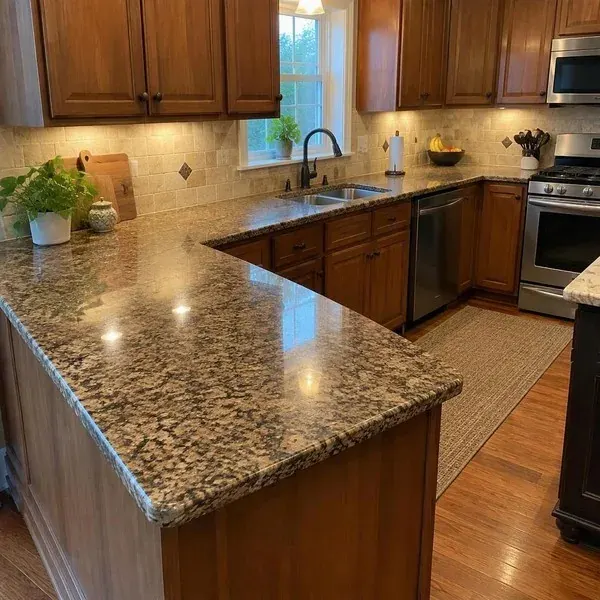
Restored eased edge on a brown granite peninsula countertop after edge repair
Answers from our team

Edge Profile Questions

The eased edge is the most popular choice today because it looks clean, works with every material and resists chipping. Half bullnose is a close second in family kitchens.

Which countertop edge is least likely to chip?

Rounded and softened edges, such as eased, half bullnose and full bullnose, resist chipping best. Sharp square corners and the thin points on some decorative profiles are the most vulnerable.

Can you change the edge on an existing countertop?

Sometimes. Because shaping removes stone, an existing edge can only be reshaped into a profile that fits within the current one, such as turning a square edge into an eased or rounded edge. Ask us to look at your countertop to see whether it is practical.

Does the edge profile affect a waterfall or mitered island?

Yes. A waterfall or mitered island needs clean 45-degree joints, so the top edge is usually kept simple, like an eased edge, to keep the lines continuous. Detailed profiles do not wrap around a mitered corner well.

Request a quote

Choose Your Edge

Not sure which profile suits your stone and your kitchen? Ask us at your estimate, and your written quote will list the edge you choose so there are no surprises.

Call (667) 400-3297
Call (667) 400-3297Quote