Open 7 days: Mon to Sat 7am to 9:30pm, Sun 9am to 9pmLicensed and insured, MHIC #1459775921 Moravia Park Dr b6, Baltimore, MD 21206
Countertop services in Baltimore

Countertop Repair in Baltimore

TopStone Granite is a Baltimore countertop fabricator and installer that also repairs stone countertops. We fix chips, cracks, worn edges, split seams, dull spots and loose undermount sinks in granite, quartz, marble and quartzite for homeowners, landlords and businesses across Baltimore and the surrounding counties.

Search for countertop repair in Baltimore and most of what you find is repair kits and restoration companies based out of state. We are a local shop on Moravia Park Drive with 15+ years of stone work and 650+ jobs completed. The same color matching, edge shaping and polishing skills we use to build countertops are what make a repair disappear.

We also repair tops we did not install, including older granite kitchens and builder-grade vanities. TopStone Granite is licensed and insured, and you can verify MHIC #145977 on the Maryland Home Improvement Commission license lookup.

Stone countertop edge rebuilt and polished at an outside corner after a chip repair in Baltimore
Licensed and insured
MHIC #145977
  • 15+years fabricating and installing
  • 650+countertop jobs completed
  • 7 daysopen every day of the week
  • Localshop on Moravia Park Drive, Baltimore

Our Countertop Repair Services

Most countertop damage is local: one chipped corner, one cracked sink rail, one seam that has opened up. That kind of damage can usually be repaired in place, without pulling the top or touching your cabinets. Here is what our countertop repair service covers.

  • Chip and pit fills on edges, corners and around sinks
  • Crack stabilization and color-matched crack fills
  • Edge rebuilds and re-profiling
  • Seam re-setting and leveling of uneven seams
  • Scratch, dull spot and etch removal by honing and polishing
  • Undermount sink reattachment
  • Stain removal and resealing of the repaired area

Countertop edge repair deserves its own mention because edges take most of the abuse. A chipped bullnose, eased or ogee edge is rebuilt with tinted epoxy, left slightly proud, then shaped back to the original profile and polished to match the sheen.

When an edge has dozens of small chips, it can make more sense to re-profile the whole run, for example easing a sharp square edge so it resists future chips. Our guide to countertop edge profiles shows how each shape holds up.

Some damage is not a repair job. A slab broken into several pieces, a top that has dropped because the cabinet underneath failed, or a surface worn evenly everywhere is better served by replacement or resurfacing, and we will tell you so.

We focus on natural and engineered stone. If your countertop is laminate or solid surface, call before booking and ask whether it is a fit.
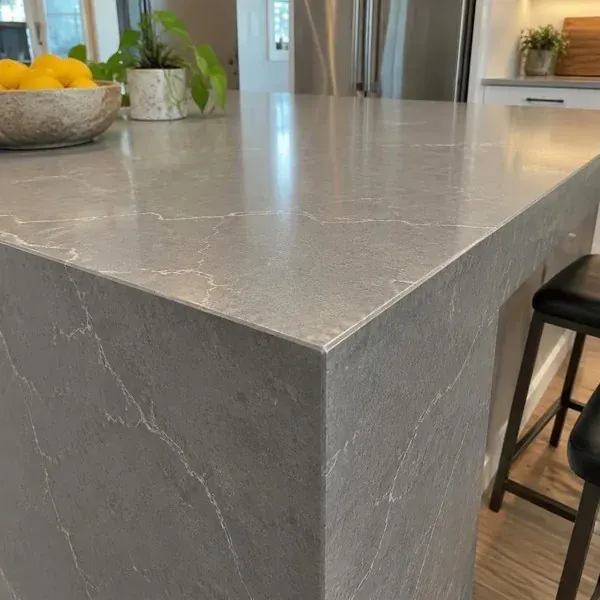
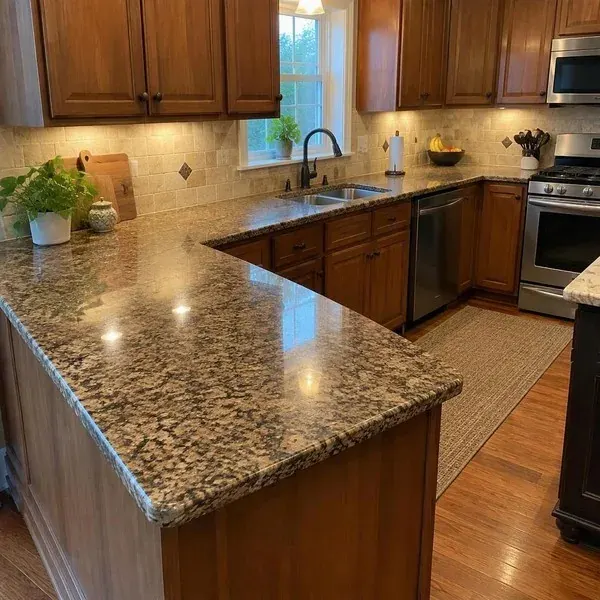
Restored countertop edge profile running the length of a kitchen counter after edge repair

Common Countertop Problems We Fix

These are the problems behind most stone countertop repair calls. Each one links to the page that covers it in depth.

Chips on Edges and Around Sinks

Chips are the most common stone countertop repair: a dropped pot, a cast iron pan or a dishwasher door catches the edge and takes out a flake. We fill the chip with resin tinted to your stone, then level and polish it so it reads as part of the edge. See granite countertop repair for how the fill is built.

Cracks and Fissures

Not every line in stone is a crack. Natural fissures are part of how granite and marble formed, while a true crack catches a fingernail and often shows on the edge or underside. Our article on what to do about a crack in a granite countertop explains how to tell the difference.

Scratches and Dull Spots

Light scratches and dull patches can often be polished out with fine diamond abrasives. Deeper wear across a whole surface is a refinishing job instead. Our countertop resurfacing page covers when a full refinish makes sense.

Worn or Damaged Edges

Corners near doorways and the edge in front of the sink wear first. We rebuild missing corners with color-matched fill and shape them back to the original profile. If the whole edge is beaten up, re-profiling it to a softer shape is an option.

Separated or Uneven Seams

Seams open when the original epoxy fails or the cabinets shift. We clean out the old filler, pull the two pieces back level and refill the joint with tinted epoxy. One side sitting higher than the other, called lippage, can be ground flush and re-polished.

Loose or Sagging Undermount Sinks

A gap between sink and stone, or a sink that drops when you fill it, means the mounting has failed. Reattaching it properly stops leaks into the cabinet before they rot the base. Our undermount sink repair page explains the fix.

Etching and Stains

Dull rings from lemon juice or wine on marble are etches, not stains, and they come out by honing and polishing. Dark oil spots on granite usually lift with a poultice. See marble countertop repair for etching and stone sealing and polishing for protecting the surface afterward.

Repair by Countertop Material

Each stone fails in its own way, so the repair method changes with the material. Quartzite repairs follow the granite approach because it is a hard natural stone that takes a polish the same way.

Granite

Granite is hard but brittle, so it chips at edges and cracks across narrow sink rails. Its mixed crystals make color matching a blend of several tints. Read more about granite chip and crack repair.

Quartz

Engineered quartz is mostly ground stone held in resin, and the resin is the weak point for heat. Edge chips and scorch marks from hot pans are the classic quartz repairs. See quartz countertop repair.

Marble

Marble is soft and reacts with acids, so etching and scratching are everyday problems. Restoration means honing and polishing more than filling. Learn about marble repair and polishing.

Worn Surfaces

When the problem is the whole surface rather than one spot, a full refinish restores the shine in a single visit. Compare options on our resurfacing and refinishing page.

Coated Surfaces

An epoxy coating covers a dated or worn top with a new seamless finish. It is a cosmetic makeover, not a stone repair. Find out more about epoxy countertop coating.

How Countertop Repair Works

Every repair follows the same basic sequence, whatever the stone. Skipping a step, especially cleaning and drying, is why many DIY fills yellow, shrink or pop out after a few months.

  1. Photos or a visit. You email photos or we look at the damage in person to judge what can be done.
  2. Assessment. We check whether the damage is cosmetic or a sign of a bigger problem, such as a sagging cabinet under a crack.
  3. Cleaning and drying. Oils, soap film and moisture are removed so the fill can bond to clean stone.
  4. Color matching. Resin is tinted on site against your actual countertop, in your actual light.
  5. Fill and cure. The fill is applied slightly proud of the surface and allowed to harden.
  6. Level and polish. The excess is shaved flush, then polished through finer abrasives until the sheen matches.
  7. Seal. On granite, marble and quartzite, the repaired area is sealed. Quartz does not need sealing.

A single chip is typically about an hour or two of work on site, and several repairs in one kitchen take longer. Most fills reach working hardness within hours, though it is wise to go easy on the spot for the first day.

Email Photos of the Damage First

Good photos help us tell you, before anyone drives out, whether a repair is likely to blend and what kind of visit it needs. Email them to info@topstonegranite.com with your address and a short note. Here is how to shoot them so they are useful.

  • One wide shot of the whole countertop, so we can see the stone color and pattern.
  • One close-up of each damaged spot, with a coin or tape measure beside it for scale.
  • A low-angle shot along the edge or seam, with light coming from the side, to show depth and height differences.
  • The underside, if a crack runs near the sink and you can see it from inside the cabinet.
  • Daylight if possible. Warm kitchen bulbs shift the color and make matching harder to judge.

Tell us the material if you know it, roughly how old the countertop is, and how the damage happened. Photos are a starting point, and most repairs are confirmed in person, because color matching is judged against the real stone.

Repair, Resurface or Replace?

Repair is the right call more often than people expect, but it is not always the right call. This is the honest version of the decision.

Situation Usually best Why
One to a few chips, solid or speckled stone Repair Fills blend well in busy patterns and dark colors
Hairline crack, no height difference Repair Stabilizing and filling stops it spreading and hides most of the line
Chip or crack in white stone or bold veining Repair, with honest expectations Color can be matched, but the spot may be visible up close
Dull, scratched or etched surface all over Resurface Polishing the whole top gives an even finish
Dated color you no longer like Coating or replace Repair restores the stone you have, it does not change it
Crack with one side higher than the other Fix support, then repair or replace The cabinet or support underneath has usually moved
Several broken pieces or repeated cracking Replace Fills cannot restore strength the slab has lost

If a repair will still show, we tell you before we start, not after. When refinishing is the better answer, our countertop resurfacing page explains the process, and when replacement wins, see countertop installation.

Countertop Repair Cost in Baltimore

Repair pricing depends on the job, so we quote after seeing photos or the damage itself. These are the factors that move the price.

  • Number of spots. Several chips fixed in one visit cost less per chip than separate trips.
  • Color and pattern. Solid and speckled stones match quickly, while white stone and heavy veining take more layering and time.
  • Type of damage. A surface chip is simpler than a broken corner, a long crack or a seam that must be re-leveled.
  • Edge profile. Rebuilding an ogee or bullnose takes more shaping than a flat eased edge.
  • Extra steps. Removing and resetting a sink, stain removal, or sealing the whole top adds time.
  • Access and location. Travel within our roughly one-hour service radius and tight rowhome kitchens can affect the visit.

Compared with replacing a countertop, a repair is usually a small fraction of the cost. For full replacement and installation pricing, see our Baltimore countertop cost guide.

Answers from our team

Countertop Repair FAQs

Will a countertop repair be invisible?

On dark, speckled granite, a good chip repair is usually very hard to find. On white quartz, white marble and stones with bold veining, the color can be matched but the spot may still be visible up close in raking light. We set expectations for your specific stone before we start.

How long does a chip repair last?

A properly cleaned, color-matched and cured epoxy or acrylic fill bonds to the stone and lasts for years under normal use. Fills fail early when they are applied over grease or moisture, which is the usual problem with DIY repairs. A fresh impact in the same spot can still chip it again, just as it would chip the stone.

Can you repair a countertop you did not install?

Yes. We repair stone countertops installed by other companies and by previous owners. If your top is still under another installer's warranty, check that warranty first so a third-party repair does not affect your coverage.

Should I use a countertop repair kit instead?

A kit is fine for a tiny chip on a dark, busy granite away from the edge. Kits do poorly on edges, cracks, seams and light colors, because they cannot rebuild a profile or match a pale stone. A failed kit repair also has to be ground out before a proper fix, which adds work.

Do you repair countertops outside Baltimore City?

Yes. We serve Baltimore and the area within about an hour's drive of our Moravia Park Drive shop, including Baltimore County, Howard County and Anne Arundel County. See the areas we serve for details.

Can a cracked countertop be repaired without removing it?

Almost always. Crack fills, seam repairs and edge rebuilds are done with the top in place. Removal is only needed when the support underneath has failed or the piece is broken through and must be replaced.

Request a quote

Book a Countertop Repair

Tell us what is damaged and where, or email a few photos to info@topstonegranite.com first. We will walk you through your repair options and price before any work starts.

Call (667) 400-3297
Call (667) 400-3297Quote