Open 7 days: Mon to Sat 7am to 9:30pm, Sun 9am to 9pmLicensed and insured, MHIC #1459775921 Moravia Park Dr b6, Baltimore, MD 21206
Countertop Repair

Granite Countertop Repair in Baltimore

TopStone Granite repairs chipped, cracked, pitted and stained granite countertops for Baltimore homeowners and businesses. We fix edge chips beside sinks and dishwashers, cracks across sink rails, open seams and dark oil spots, then polish and seal the area so it blends back into the slab.

Granite is hard, but it is also brittle and full of mixed crystals, which makes it easy to chip and tricky to color match. As a fabricator with 15+ years in stone and 650+ jobs completed, we know how granite is cut, rodded, seamed and polished, which is exactly what you need to know to put it back together.

We repair granite we installed and granite we did not, in kitchens, baths and bars across Baltimore and the surrounding area. TopStone Granite is licensed and insured under MHIC #145977.

Chipped granite countertop edge rebuilt and polished beside a kitchen sink cutout in Baltimore
Licensed and insured
MHIC #145977
  • 15+years fabricating and installing
  • 650+countertop jobs completed
  • 7 daysopen every day of the week
  • Localshop on Moravia Park Drive, Baltimore

Our Granite Countertop Repair Services

Most granite damage can be repaired with the countertop in place, in one visit. Our granite countertop repair work covers:

  • Chip fills on edges, corners and sink rims
  • Crack stabilization with tinted epoxy, and reinforcement where needed
  • Pit filling for spots where crystals have popped out
  • Seam repair, including re-leveling seams that have shifted
  • Edge rebuilds for broken corners and missing sections of a profile
  • Stain removal with a poultice for oil and water marks
  • Re-polishing to bring the repaired area back to the slab's sheen
  • Resealing the repaired area so it does not absorb spills

Rounded edges like a full or half bullnose are the hardest to rebuild because the curve has to be shaped by hand after the fill cures. Done right, the profile runs through the repair without a flat spot. For an overview of repairs on every stone, visit our countertop repair hub.
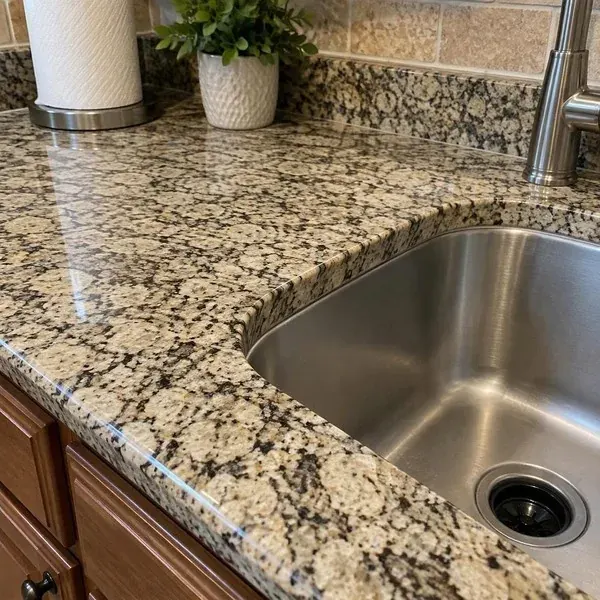
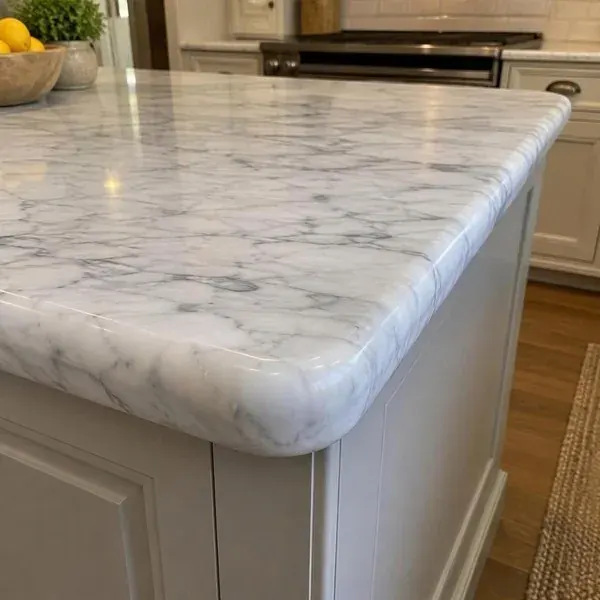
Repaired bullnose granite countertop edge with the chip filled, shaped and polished to match

Granite Damage We See Most Often

Granite fails in predictable places. Knowing where it breaks, and why, tells us whether a repair is cosmetic or a warning sign.

Chips Along the Sink and Dishwasher Edge

The front edge by the sink takes hits from pots, heavy dishes and faucet sprayers. Over a dishwasher, the opening door can knock the underside of the edge. These chips are usually small and fill well, especially on darker granites.

Cracks Across Sink Rails and Cooktop Cutouts

The narrow strips of stone in front of and behind a sink or cooktop are the weakest parts of any granite top. Good fabricators reinforce them with steel or fiberglass rods set into the underside, and tops that skipped that step are the ones that crack. Leaning on the sink edge or a cabinet that settles can finish the job.

Natural Fissures vs. Structural Cracks

Run a fingernail across the line. A fissure is a natural seam in the crystal structure and your nail will glide over it, while a crack usually catches.

Look at the edge and, if you can, the underside from inside the cabinet, because a crack often shows through and a fissure rarely does. Our article on a crack in a granite countertop covers this in more detail.

Pits and Missing Crystals

Coarse-grained granites can lose small flakes of mica or feldspar, leaving pits that collect crumbs. Pits are a natural trait, not a defect, but they can be filled with clear or tinted resin so the surface feels smooth again.

Oil and Water Stains

Cooking oil darkens granite in a blotch that does not wipe off. Water marks around faucets often come from minerals or a worn seal. We lift oil stains with a poultice that draws the oil back out of the stone, then reseal the spot.

How We Repair Chips and Cracks in Granite

A good granite repair is about preparation and color, not just glue. These are the three stages that decide whether a fill lasts and disappears.

Cleaning and Drying the Damage

Cooking oil, soap film and moisture inside the chip stop resin from bonding. We clean the area with a solvent and let it dry fully before any fill goes in. Skipping this is why many repair kit fills turn cloudy or pop out.

Tinted Epoxy or Acrylic Fill

Granite is a mix of crystals in several colors, so we tint the fill to the dominant background color and sometimes add fine specks to break up the patch. Epoxy is used for cracks and larger fills, while fast-setting acrylic adhesives suit small chips. The color is matched on site, against your stone, in your light.

Curing, Leveling and Polishing

The fill is left slightly proud of the surface and allowed to harden. We shave it flush with a razor blade, then polish through progressively finer diamond pads until the gloss matches the surrounding granite. A matte spot is a giveaway, so sheen matters as much as color.

Fixing Separated Granite Seams

Granite seam repair is one of the most common calls on older tops. Seams open or develop a height difference, called lippage, when the original epoxy breaks down, the cabinets settle, or the seam was never set level in the first place.

To repair a seam, we cut out the failed filler and clean both edges back to sound stone. The pieces are pulled tight and level with a seam setter, a vacuum-cup clamp that grips both sides, and the joint is refilled with color-matched epoxy. Any remaining lippage is ground flush and re-polished.

If a seam keeps opening, the cabinet underneath is usually moving, and that has to be shimmed or fixed first. You can read about how seams are planned on a new top on our seam matching page. Seams that open right at the sink often go together with a failing sink mount, which our undermount sink repair page covers.

When a Cracked Granite Countertop Should Be Replaced

We would rather tell you a repair will not work than take your money for one that fails. Replacement, of that piece or the whole run, is usually the smarter choice in these cases.

  • The crack has a height offset. One side sitting higher than the other means the stone has moved and lost support.
  • The crack came from cabinet failure. If the base has sagged or rotted, a fill will crack again until the support is rebuilt.
  • The same piece keeps cracking. Repeated cracks point to a slab that was under-supported or stressed from the start.
  • The piece is broken through in several places. A fill restores looks, not the strength of a split slab.

When you do replace, matching a 15-year-old granite to a new slab is hard, so it is often a whole-kitchen decision. Our granite countertops page covers choosing a new stone.

Granite Repair Cost Factors

We price each granite repair after seeing the damage, in photos or in person. These are the factors that drive it.

  • How many spots. Several chips in one visit cost less each than separate trips.
  • Color difficulty. Black and dark speckled granites match quickly, while white granites and stones with large crystals or movement take longer.
  • Chip, crack or seam. A small chip is the simplest job, while a long crack or a seam that must be re-leveled takes more time and material.
  • Edge profile. Rebuilding a bullnose or ogee needs more hand shaping than an eased edge.
  • Stain removal and sealing. A poultice treatment or resealing the full top adds to the visit.

For replacement and installation costs, see our Baltimore countertop cost guide.

Answers from our team

Granite Repair FAQs

Is a crack in granite a structural problem?

Usually not. Most cracks in granite countertops are cosmetic and stay stable once they are filled. A crack is a structural concern when one side has dropped, the crack keeps growing, or the cabinet underneath has shifted, and in that case the support needs fixing first.

How much does it cost to fix a chip in granite?

It depends on the size of the chip, where it is on the edge, and how hard your granite is to color match. Fixing several chips in one visit lowers the cost per chip. Email photos to info@topstonegranite.com and we can tell you what the repair involves.

Do I need to reseal granite after a repair?

Yes, for the repaired area at least. Cleaning and polishing during the repair strips any existing sealer around the spot, so we reseal it to keep oil and water out. If the rest of the top fails a water test, our stone sealing service covers the full surface.

Can you fix a granite seam that has opened up?

Yes. We remove the old filler, pull the pieces level with a seam setter, and refill the joint with color-matched epoxy. If the cabinet below is moving, we point that out so the seam does not open again.

Request a quote

Schedule a Granite Repair

Email photos of the chip, crack or seam to info@topstonegranite.com, or call to set up a visit. We will tell you how well the repair should blend before we start.

Call (667) 400-3297
Call (667) 400-3297Quote