Open 7 days: Mon to Sat 7am to 9:30pm, Sun 9am to 9pmLicensed and insured, MHIC #1459775921 Moravia Park Dr b6, Baltimore, MD 21206
Countertop guide

How Much Does Countertop Installation Cost in Baltimore?

TopStone Granite fabricates, installs and repairs granite, quartz, marble and butcher block countertops for homeowners and businesses across Baltimore and the surrounding counties. After 15+ years and 650+ completed jobs, we know that the per-square-foot number is only part of what you pay.

This guide explains how countertop pricing works in the Baltimore area: typical published ranges by material, sample totals with the math shown, the line items that move a quote up or down, and what repairs involve. We are licensed and insured under MHIC #145977.

Every project is different, so the only firm number is a written, itemized quote for your layout. Use this page to set a realistic budget and compare quotes on equal terms.
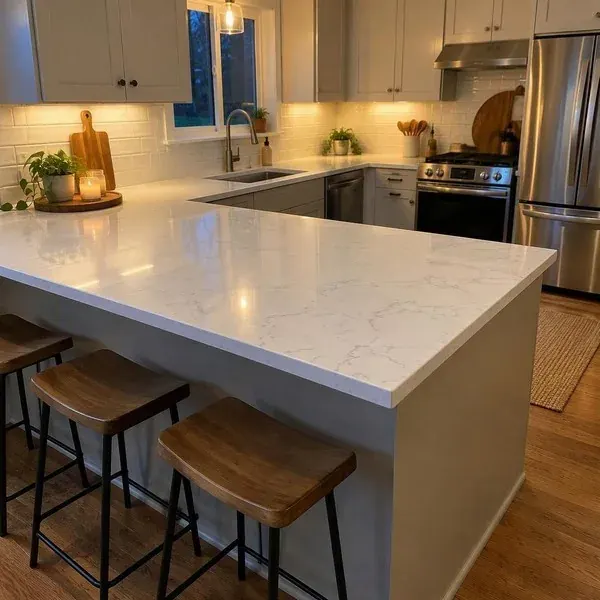
White quartz peninsula countertop with bar stools, a typical project in our Baltimore countertop cost guide
Licensed and insured
MHIC #145977
  • 15+years fabricating and installing
  • 650+countertop jobs completed
  • 7 daysopen every day of the week
  • Localshop on Moravia Park Drive, Baltimore

Countertop Prices per Square Foot by Material

The ranges below are typical installed prices published by fabricators in the Baltimore and Washington area, not TopStone's price list. They include the slab, fabrication and installation, and they assume a standard edge. Your written quote from us replaces these with real numbers for your job.

Material Typical installed price per sq ft Why the range is wide
Granite About $40 to $100 or more Common colors vs. rare and exotic slabs
Quartz About $50 to $140 or more Entry, mid and designer brand tiers
Marble About $65 to $250 Stone type, grade and origin
Quartzite About $65 to $200 Hard to cut, limited supply
Butcher block No local published range found Wood species and grain construction

Granite

Granite has the widest spread of any stone because two slabs can come from very different quarries. Common colors produced in volume sit at the low end, while exotic slabs with dramatic movement climb past $100 per square foot. Learn what to look for on our granite countertops page.

Quartz

Quartz is priced mostly by brand tier and design. Solid colors and simple speckled patterns cost the least, while marble-look designs with long, through-body veining sit at the top. See how the tiers compare on our quartz countertops page.

Marble

Marble ranges from familiar Carrara to rare Calacatta slabs that command premium prices. Fabrication also takes extra care because marble is softer and scratches and etches more easily. Read about the trade-offs on our marble countertops page.

Quartzite

Quartzite costs more to fabricate because it is harder than granite and wears down cutting tools faster. Popular white quartzites are also in high demand, which keeps slab prices up. Our quartzite countertops page covers how to buy it with confidence.

Butcher Block

Butcher block generally costs less than most natural stone, but price depends on wood species, edge grain versus end grain construction, and finish. We price it per project rather than quoting a general range. Details are on our butcher block countertops page.

Sample Project Totals

These examples apply the published market ranges above to common layouts so you can see how the math works. They are estimates for budgeting, not TopStone quotes, and they leave out extras like removal, plumbing and premium edges. Measure your own counters in square feet and multiply to get your starting range.

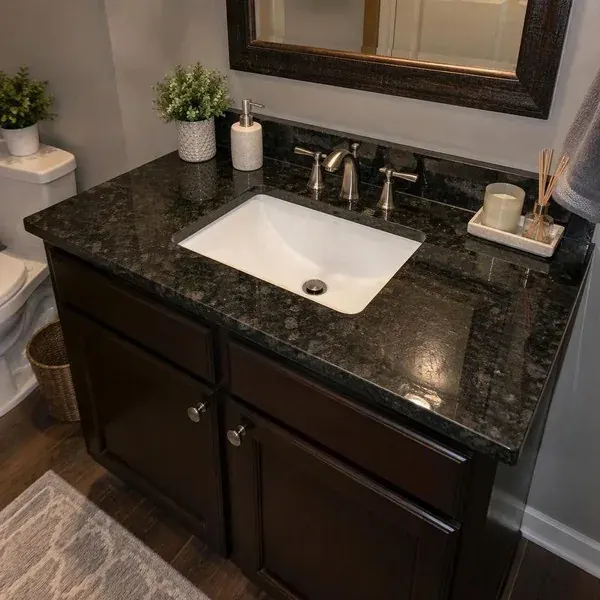
Small powder room vanity top, an example of a small countertop project

Bathroom Vanity Top

A single-sink vanity top is about 5 square feet. At the published market rates, that works out to roughly $200 to $500 in granite or $250 to $700 in quartz before the sink cutout.

Small jobs often carry a minimum charge at most shops, so the real number usually lands higher. A remnant (a leftover piece from a larger slab) can bring the material cost down; ask us about remnant pricing for a bathroom vanity countertop.

Standard Kitchen

Assume an L-shaped kitchen with about 22 linear feet of 25-inch-deep counter, or roughly 45 square feet. At the published rates, that is about $1,800 to $4,500 in granite or $2,250 to $6,300 in quartz.

One sink cutout, a cooktop or range opening, and one or two seams are typical at this size. Those items, plus old top removal, are where quotes for the same kitchen start to differ.

Kitchen With an Island

Add a 30-square-foot island (about 8 feet by 3 feet 9 inches) to the kitchen above, for roughly 75 square feet in total. At the published rates, that is about $3,000 to $7,500 in granite or $3,750 to $10,500 in quartz.

Islands raise cost beyond the square footage. A seating overhang needs hidden support brackets or a subtop, a large island may need a seam, and a prep sink or waterfall end adds fabrication time.

What Drives Countertop Cost Up or Down

Two kitchens with the same square footage can be priced far apart. These are the line items that make the difference.

Slab Grade and Color

Common, high-volume colors cost less than rare or exotic slabs. Bookmatched or vein-matched layouts also use more material, because the fabricator has to cut pieces from specific spots on the slab. Our seam matching page explains why that matters.

Edge Profiles and Thickness

A simple eased edge is the most economical choice. Ogee, full bullnose and mitered edges take more shaping time and are often priced per linear foot. Compare the options in our countertop edge profiles guide.

Cutouts and Seams

Every undermount sink, cooktop, faucet hole and outlet opening is extra cutting and polishing labor. Seams take time to place, match and bond. See what goes into a clean opening on our sink and appliance cutouts page.

Removal, Disposal and Plumbing

Tearing out old tops is heavier work when they are tile set in mortar or stone glued to the cabinets. Disconnecting and reconnecting the sink and faucet may be part of the job or a separate line. Ask every company you get a quote from to show both as separate line items.

Access: Rowhome Stairs and Long Carries

Baltimore's rowhomes bring their own cost factor: narrow doorways, tight stairs and long carries from the street. A slab that cannot make the turn may need an extra seam or more installers. Our rowhome countertop planning guide shows how to plan for it.

Countertop Repair Costs

Repair is usually a fraction of replacement, and the price depends on the problem rather than square footage. A single chip on an edge is a short visit, while a cracked top, a separated seam or a sagging undermount sink takes more time and materials.

The main drivers are the material, how many spots need work, how hard the color is to match, and whether polishing is needed to blend the repair. You can email photos of the damage to info@topstonegranite.com so we can tell you what the repair involves. Start with our countertop repair overview, or see stone sealing and polishing for dull or stained tops.

Ways to Save Without Cutting Corners

You do not have to choose a cheaper stone to lower your price. Small layout and finishing choices often save more.

  • Stick with a standard edge. An eased edge looks clean on any stone and costs less than an ogee or mitered edge.
  • Ask about remnants for small tops. Vanities, laundry rooms and bar tops can often be cut from leftover pieces.
  • Keep the layout simple. Fewer inside corners, curves and cutouts mean less fabrication time.
  • Pick a common color. Many popular granites and quartz patterns sit at the lower end of their range.
  • Keep the sink where it is. Moving plumbing adds cost and may require a permit.
  • Consider refinishing. If your current stone is sound, countertop resurfacing may solve the problem for less than new tops.

What a TopStone Quote Includes

We give every customer a written, itemized quote, so you can compare it line by line with other offers. Typical line items include:

  • Material by square foot, with the stone or brand and color named
  • Fabrication, including the edge profile and thickness
  • Each sink, cooktop and faucet cutout
  • Seam locations and any support for overhangs
  • Removal and disposal of existing countertops
  • Sink and faucet disconnect and reconnect, when part of the job
  • Sealing for natural stone, when needed
  • Installation and cleanup

If another quote looks much lower, check which of these lines it leaves out. Your quote also spells out the warranty terms for your job, which you can read more about on our warranty page.

Answers from our team

Countertop Cost FAQs

What is the average cost to install countertops?

For a typical Baltimore-area kitchen, published installed ranges run from a few thousand dollars to well over $10,000, depending on material and size. One regional fabricator lists a typical kitchen at $4,200 to $5,300. The fastest way to get a real number is to measure your counters and request a written quote.

What countertop material is cheaper than granite?

Butcher block and laminate usually cost less than granite, and entry-level quartz overlaps with common granite colors. Within granite itself, high-volume colors cost far less than exotic slabs. See our countertop materials guide to compare options.

Does Home Depot charge for countertop installation?

Big-box stores sell installed countertops and use contracted installers, so installation is built into the price rather than free. As with any company, removal, edge upgrades, cutouts and plumbing may be priced separately. Compare quotes line by line rather than on the bottom line alone.

Do you offer financing?

Ask us about payment options when you request your quote. We will explain how payment works for your project before you commit.

Request a quote

Get an Exact Price for Your Project

Send us your measurements or a rough sketch, or book a visit, and we will put together a written, itemized quote for your countertops. Every line item is spelled out so you know exactly what you are paying for.

Call (667) 400-3297
Call (667) 400-3297Quote