Open 7 days: Mon to Sat 7am to 9:30pm, Sun 9am to 9pmLicensed and insured, MHIC #1459775921 Moravia Park Dr b6, Baltimore, MD 21206
Custom Fabrication

Custom Countertop Inlays and Logo Branding in Baltimore

A countertop inlay is a shape cut from one material and set into another so the two sit perfectly flush, like a medallion, a border, a monogram or a company logo. TopStone Granite designs and fabricates custom countertop inlays for restaurants, bars, offices and reception areas, and for homeowners who want an island nobody else has.

Inlay work draws on the same skills as every top we make: accurate cutting, tight joints and polishing two materials to one smooth surface. Our team has 15+ years of fabrication experience and 650+ completed jobs across Baltimore and the surrounding region.

We are a licensed and insured Maryland home improvement contractor, MHIC #145977. Bring us a sketch, a logo file or just an idea.

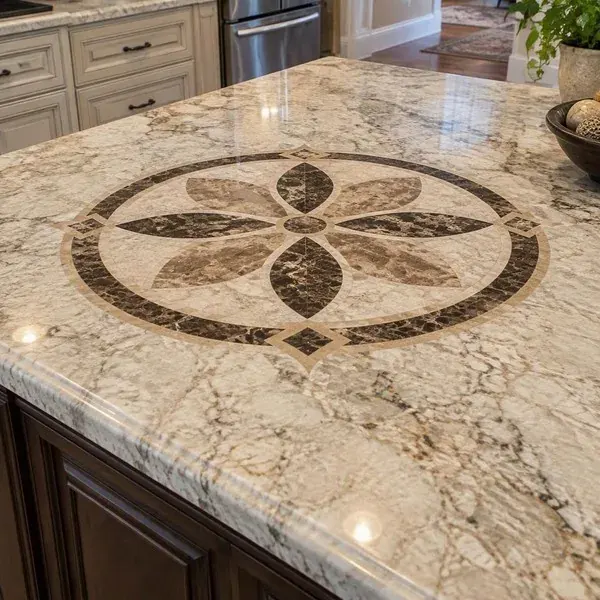
Circular contrasting stone medallion inlaid flush into a custom countertop by a Baltimore fabricator
Licensed and insured
MHIC #145977
  • 15+years fabricating and installing
  • 650+countertop jobs completed
  • 7 daysopen every day of the week
  • Localshop on Moravia Park Drive, Baltimore

Our Custom Inlay and Logo Branding Services

An inlay turns a countertop into a signature piece. It is one of the most detailed forms of custom countertop fabrication, and it covers:

  • Business logos and brand marks on bar tops, host stands and reception desks
  • Lettering, house names and monograms
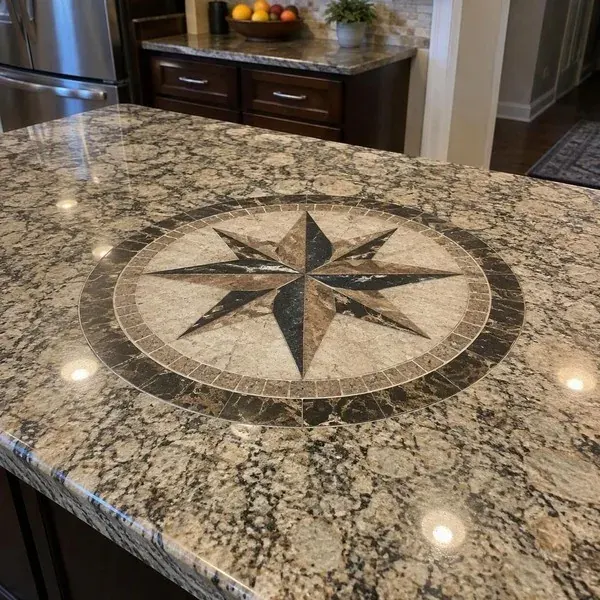
  • Decorative medallions and compass or geometric patterns for island centers
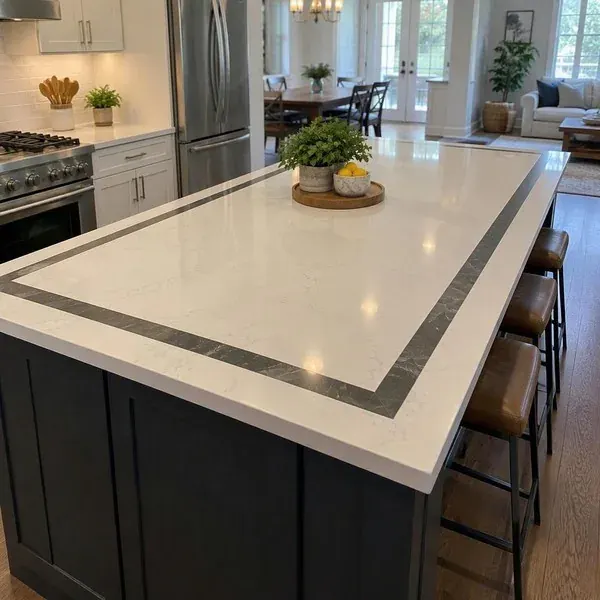
  • Contrasting stone strips and borders around an island or bar edge
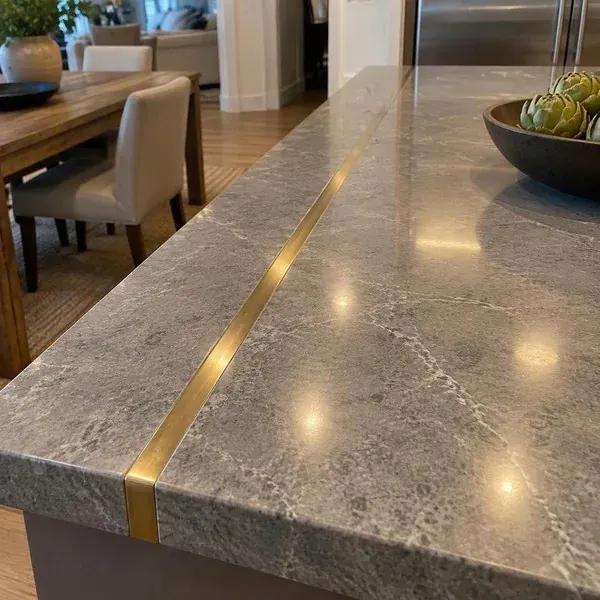
  • Metal inlay strips, such as brass, set into a stone surface

To sit flush, the host slab is cut with an opening or a pocket in the exact shape of the design. The inlay piece is cut to match, bonded in place with epoxy and then ground and polished with the surrounding stone until the two feel like one surface. Precision cutting, typically by waterjet in the industry, is what keeps the joint lines thin and even.

There are two basic builds. A full-depth inlay replaces a section of the slab all the way through and rests on the cabinet or a subtop below, which suits larger medallions and borders. A shallow pocket inlay sits partway into the slab, which suits thin strips and metal.

Close-up of a finished countertop inlay with a tight, polished joint between two stones

Inlay Design Options

Most inlays fall into one of three families. Each comes with its own design limits worth knowing before you fall for a sketch.

Thin brass metal inlay strip set flush into a polished stone countertop surface

Contrasting Stone Inlays

Pairing a light stone with a dark one gives the strongest contrast, such as white marble in black granite. The two materials should be close in hardness so they wear evenly.

Soft marble set into hard granite can wear into a slight dip over the years where people wipe and set things down most.

Business Logos and Lettering

Logos translate to stone well when lines are bold and shapes are simple. Very thin lines, fine serifs and small text are where stone reaches its limit.

As a rule of thumb, lines thinner than about 1/8 inch and letters under an inch or two tall get fragile. We may suggest simplifying a mark so it reads clearly and survives daily use.

Decorative Strips and Borders

A contrasting border around an island or a single strip across a bar top is the simplest inlay and often the most elegant. Straight strips are faster to cut and fit than curves.

Metal strips add a sharp line of color and suit modern and hospitality designs.

How an Inlay Is Designed and Cut

Inlays need more planning than any other countertop detail, because the artwork has to become a cutting path. The process runs like this:

  1. Artwork: you send your logo or design, ideally as a vector file.
  2. Proof: we prepare a layout showing size, position on the top and the materials, and you approve it before any cutting.
  3. Material selection: we pick the host stone and inlay stone together so color, hardness and thickness work.
  4. Precision cutting: the opening in the host slab and the inlay piece are cut from the same design file so they match.
  5. Dry fit: pieces are fitted without adhesive to check joints and alignment.
  6. Bonding: the inlay is set in color-matched epoxy.
  7. Polishing flush: both materials are ground and polished together to one level.
  8. Sealing: natural stone parts are sealed so the joint and surface resist stains.

Brand colors deserve a frank conversation. Stone comes in the colors nature and manufacturers make, so an exact Pantone match is rarely possible. We help you pick the closest stone, or a metal accent, so the mark still reads as yours.

The host material matters too. Engineered quartz has a factory polish that is hard to recreate by hand, so inlays into quartz take careful planning, while granite and marble are more forgiving to polish flush.

Inlays add time to fabrication, so we build them into your schedule from the start. Pricing depends mostly on design complexity, size, the number of pieces and the materials, and our countertop cost guide explains how custom details fit into an overall budget.

Where Inlays Work Best

The best spots for an inlay are places people see and touch lightly, not places that take a beating.

Strong locations include reception desks and host stands, where a logo greets every visitor, and bar tops, where a brand mark or border sets the tone. Our commercial countertop and restaurant countertop work often includes this kind of branding. At home, the center of an island, a bar or coffee station and a vanity top are all good stages.

Keep inlays away from cooktop edges, where hot pans and heat cycles stress the joints. Avoid sink rims and the main prep zone too, since standing water and heavy chopping are hard on epoxy lines and soft inlay stones.

Bars need one more thought. Citrus, wine, cocktails and sanitizers etch marble, so a marble logo on a busy bar top will dull quickly. Granite, quartz or metal inlays hold up far better under nightly service.

Outdoor counters are generally a poor fit for epoxy-bonded inlays. Direct sun can yellow many epoxies, and Maryland freeze and thaw cycles work on every joint, so we usually steer outdoor designs toward a contrasting border cut as separate pieces instead.
Dark stone border inlay running around the edge of a light kitchen island countertop
Answers from our team

Custom Inlay FAQs

What file do you need for a logo inlay?

A vector file works best, such as AI, EPS, SVG, DXF or a vector PDF, because it can be scaled without losing sharp edges. If you only have a JPG or PNG, send it anyway. Artwork often needs to be redrawn as vectors before it can be cut, and we can talk through options.

Can an inlay be added to an existing countertop?

Sometimes, but it is riskier than building it into a new top. Cutting a pocket into an installed slab means working in place, with the chance of cracking or chipping the surrounding stone. Small inlays in solid areas are the best candidates, and we assess each one before agreeing to it.

Do inlays make countertops harder to clean or seal?

No, not when they are done right. A properly fabricated inlay is polished flush with no ridge for crumbs to catch on, so you wipe it like any other surface. Natural stone inlay pieces need sealing on the same schedule as the rest of the top, which our stone sealing and polishing service can handle.

Can an inlay be lit from below?

Translucent stones such as onyx can be backlit, which makes a lit logo or medallion possible on the right project. It has to be planned before fabrication. See our countertop lighting installation page for which stones pass light.

Request a quote

Send Us Your Logo or Design Idea

Email your logo, sketch or inspiration photos to info@topstonegranite.com with the countertop size and where it will go. We will review what is possible in stone and follow up with options.

Call (667) 400-3297
Call (667) 400-3297Quote